
Artificial Intelligence is evolving beyond simple automation tools and chatbots. A new generation of intelligent systems is emerging, capable of handling tasks, supporting decision-making, and contributing to business operations in ways that were once considered impossible.
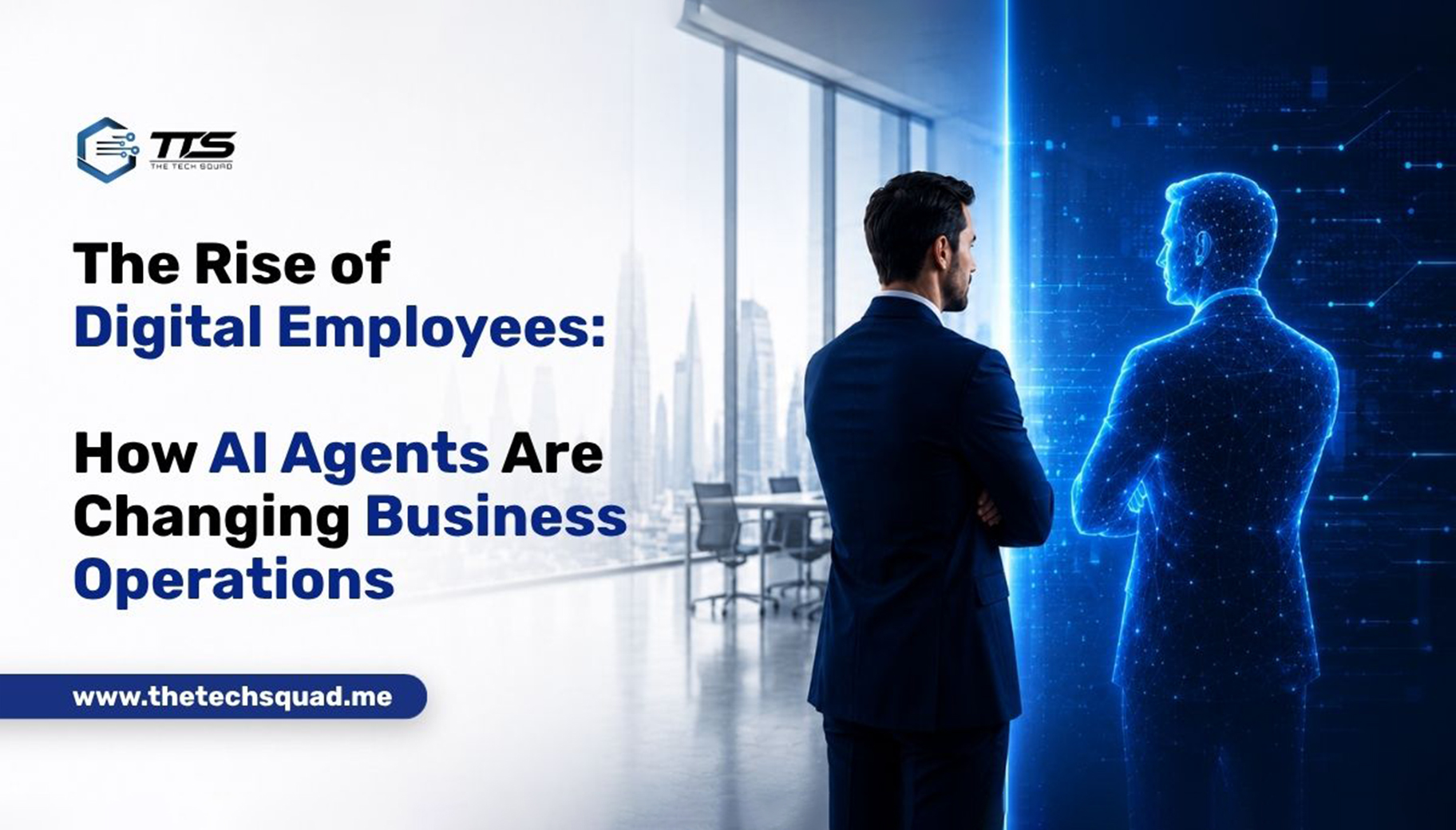
These systems are known as AI Agents, and many industry experts are beginning to describe them as the first generation of digital employees.
Across industries, businesses are exploring how AI Agents can improve efficiency, streamline workflows, enhance customer experiences, and support growth. As organizations continue their digital transformation journey, AI Agents are becoming a key part of the future workforce.
What Are AI Agents?
An AI Agent is an intelligent software system designed to perform tasks, process information, make decisions, and interact with users based on predefined objectives.
Unlike traditional automation tools that follow rigid rules, AI Agents can understand context, adapt to situations, and execute multiple tasks across different business functions.
Think of an AI Agent as a digital team member that can assist with operational activities while working continuously and consistently.
AI Agents vs Chatbots: Understanding the Difference
Many businesses still confuse AI Agents with chatbots.
While both use Artificial Intelligence, their capabilities are significantly different.
Traditional Chatbots
Traditional chatbots are primarily designed to answer questions and provide predefined responses.
They typically:
- Follow scripted conversations
- Handle simple inquiries
- Depend on predefined rules
- Have limited decision-making capabilities
AI Agents
AI Agents go much further.
They can:
- Understand context
- Execute multi-step tasks
- Access business information
- Support operational workflows
- Make recommendations
- Learn from interactions
- Automate business processes
A chatbot answers questions.
An AI Agent helps get work done.
This distinction is becoming increasingly important as businesses look for practical AI solutions that deliver measurable value.
Why Businesses Are Investing in AI Agents
Organizations are constantly searching for ways to improve productivity without significantly increasing operational costs.
AI Agents help businesses achieve this by automating repetitive tasks, supporting employees, and improving overall efficiency.
Benefits include:
- Faster response times
- Improved productivity
- Reduced manual workload
- Better customer experiences
- Increased operational efficiency
- Enhanced scalability
Businesses that successfully integrate AI Agents are often able to achieve more with existing resources.
AI Agents for Lead Generation
Lead generation is one of the most valuable applications of AI Agents.
Many businesses lose potential opportunities simply because inquiries are missed, delayed, or not managed efficiently.
AI Agents can support lead generation by:
- Responding instantly to inquiries
- Collecting customer information
- Qualifying prospects
- Scheduling meetings
- Routing leads to the appropriate teams
- Following up automatically
This helps businesses engage potential customers more effectively while reducing the burden on sales teams.
For growing organizations, AI-powered lead management can significantly improve conversion opportunities.
AI Agents for Customer Service
Customer expectations have changed dramatically.
Businesses are now expected to provide quick responses, consistent support, and seamless customer experiences.
AI Agents help organizations meet these expectations by:
- Providing 24/7 customer assistance
- Handling frequently asked questions
- Supporting customer onboarding
- Managing service requests
- Escalating complex issues when required
Unlike traditional support systems, AI Agents can understand context and provide more intelligent interactions.
This improves both customer satisfaction and operational efficiency.
AI Agents for Workflow Automation
One of the biggest challenges organizations face is managing repetitive operational processes.
Employees often spend valuable time on routine administrative activities instead of focusing on strategic work.
AI Agents can automate:
- Internal workflows
- Task management
- Data processing
- Document handling
- Information retrieval
- Reporting activities
By reducing manual intervention, businesses can improve productivity while minimizing operational bottlenecks.
Workflow automation is becoming one of the most important use cases for AI adoption across modern organizations.
Real-World Applications of AI Agents
AI Agents are already being implemented across various industries and business functions.
Common applications include:
Sales Support
Lead qualification, appointment scheduling, and customer engagement.
Customer Experience
Automated support, service management, and inquiry handling.
Operations Management
Workflow optimization, task automation, and process monitoring.
Data Processing
Classification, validation, organization, and reporting.
Administrative Support
Scheduling, information retrieval, and operational coordination.
As AI technology continues to advance, the range of applications will continue expanding.
The Future Workforce: Humans and AI Working Together
There is often concern that AI will replace human employees.
The reality is more nuanced.
The future workforce is likely to combine human expertise with AI-powered digital employees.
Humans will continue to provide:
- Strategic thinking
- Creativity
- Relationship management
- Leadership
- Complex decision-making
AI Agents will support:
- Repetitive tasks
- Operational workflows
- Information processing
- Routine interactions
- Process automation
This partnership allows organizations to become more efficient while enabling employees to focus on higher-value work.
The goal is not replacement.
The goal is augmentation.
Why Businesses Should Start Exploring AI Agents Now
The adoption of Artificial Intelligence is accelerating across every industry.
Organizations that begin experimenting with AI Agents today will gain valuable experience, operational insights, and competitive advantages.
Early adopters often benefit from:
- Increased efficiency
- Faster business processes
- Better customer experiences
- Improved scalability
- Reduced operational costs
As AI becomes more integrated into business operations, waiting may become more expensive than acting.
Final Thoughts
The rise of AI Agents marks a significant shift in how businesses operate.
From lead generation and customer service to workflow automation and operational support, AI Agents are becoming powerful digital employees that help organizations work smarter and grow faster.
Businesses that understand and embrace this transformation will be better positioned for the future.
The workforce of tomorrow will not be defined by humans or AI alone.
It will be defined by how effectively they work together.